Revolutionizing Holiday Design: The Strategic Rise of AI Prompts for Christmas Alphabets
The holiday season has always been a pinnacle moment for creative expression, where brands, educators, and independent creators vie for attention through festive visuals. In recent years, the mechanism behind generating these visuals has undergone a profound transformation. At the forefront of this shift is the Ai Prompt for Christmas Alphabets, a specialized application of generative artificial intelligence that allows users to craft custom, holiday-themed typography with unprecedented speed and fidelity. This is not merely a novelty for hobbyists; it represents a significant evolution in how professionals approach seasonal design workflows, merging artistic tradition with algorithmic precision.
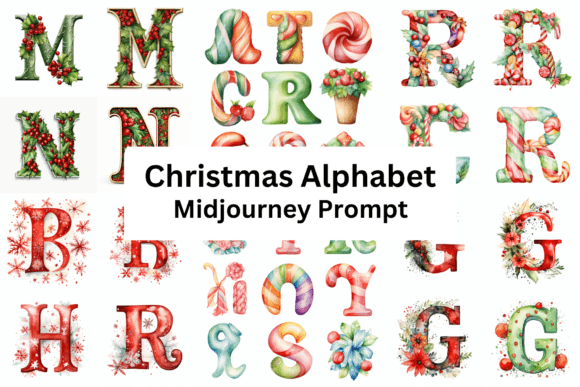
Traditionally, creating a cohesive set of Christmas alphabets—where each letter from A to Z is adorned with ornaments, snowflakes, candy canes, or holly—required hours of manual illustration or the purchase of expensive, pre-made font licenses. Today, an Ai Prompt for Christmas Alphabets serves as a dynamic bridge between a creator's vision and the final output. By leveraging natural language processing, these prompts guide image generation models to produce unique typographic assets that align perfectly with specific brand guidelines or thematic requirements. This capability addresses a growing market demand for hyper-personalization and distinctiveness in a saturated visual landscape.
The Convergence of Technology and Seasonal Creativity
The emergence of Ai Prompt for Christmas Alphabets fits seamlessly into broader industry trends where efficiency and customization are paramount. For marketers and entrepreneurs, the ability to generate bespoke assets on demand reduces reliance on stock libraries that often feel generic or overused. In an era where consumers crave authenticity, a hand-crafted look achieved through AI offers a competitive edge. The technology enables the creation of letters that do not just look "festive" but tell a story. For instance, a luxury chocolate brand might require an alphabet featuring gold-leaf textures and velvet ribbons, while a children's educational platform might need bright, cartoonish letters made of gingerbread and gumdrops.
This shift reflects a larger movement in the creative economy: the democratization of high-quality design tools. Freelancers and small business owners, who previously lacked the budget for custom typeface commissioning, can now utilize an Ai Prompt for Christmas Alphabets to produce professional-grade materials. This levels the playing field, allowing smaller entities to compete visually with larger corporations during the critical Q4 shopping season. Furthermore, it aligns with the technological trend of "prompt engineering" becoming a core skill set for modern creatives, where the ability to articulate a visual concept clearly to an AI is as valuable as the ability to draw it manually.
Why the Market is Paying Attention
The attention surrounding Ai Prompt for Christmas Alphabets stems from a fundamental change in consumer expectations and production timelines. The modern holiday cycle moves faster than ever, with campaigns launching earlier and social media content requiring constant refreshment. The traditional workflow of sketching, vectorizing, and refining a full alphabet set is often too slow for agile marketing teams. AI-driven solutions offer immediate iteration. If a initial batch of letters feels too icy or not red enough, the prompt can be adjusted instantly, and new variations generated in seconds.
Moreover, there is a psychological component to why this technology resonates. The holidays are deeply rooted in nostalgia and warmth. Generic sans-serif fonts often fail to evoke these emotions. An Ai Prompt for Christmas Alphabets allows creators to infuse specific emotional cues into the typography itself. Whether it is the texture of knitted wool for a cozy winter vibe or the gleam of glass for a New Year's celebration, the granularity of control offered by these prompts ensures that the visual tone matches the intended emotional impact. This relevance is driving adoption across sectors ranging from e-commerce packaging to digital greeting cards.
Transforming Workflows and Meeting Evolving Needs
The integration of AI prompts into holiday design workflows signifies a move away from static asset creation toward dynamic content generation. Professionals are no longer bound by the limitations of existing font files. Instead, they can tailor every curve and embellishment to fit a specific layout. This flexibility is crucial for multi-channel campaigns where a logo or headline needs to adapt to various formats, from Instagram stories to large-format billboards.
Consider the educational sector, a key adopter of this technology. Teachers and curriculum developers use Ai Prompt for Christmas Alphabets to create engaging learning materials that capture students' imaginations. Rather than using clipart that may not match the classroom theme, educators can generate a complete alphabet set that aligns with their specific lesson plans—perhaps letters formed by elves, reindeer, or winter landscapes. This customization enhances engagement and makes learning interactive. Similarly, event planners utilize these tools to design unique signage and invitations that stand out in a sea of template-based designs.
The changing preference for sustainability also plays a role. Digital-first campaigns reduce the need for physical proofing and waste. By refining designs digitally through iterative prompting before any physical production occurs, businesses can minimize errors and resource usage. This aligns with the growing corporate emphasis on sustainable practices, making the Ai Prompt for Christmas Alphabets not just a creative tool, but a responsible one.
Practical Applications and Observations
To understand the practical value, one must look at how these prompts are constructed and utilized in real-world scenarios. A successful prompt does not simply ask for "Christmas letters." It specifies lighting, material, composition, and style. For example, a marketer might input a request for "3D rendered alphabet letters made of crushed candy cane, surrounded by falling snow, soft studio lighting, macro photography style." The result is a set of assets that feel tactile and premium, ready for high-end packaging design.
Observations from early adopters suggest that the quality of output is directly correlated with the specificity of the prompt. This has led to the development of shared knowledge bases and communities where professionals exchange effective phrasing strategies. It is becoming common to see collaborative efforts where a designer provides the artistic direction and a specialist refines the Ai Prompt for Christmas Alphabets to achieve the perfect balance of whimsy and legibility. This collaboration highlights the hybrid nature of modern creative work, where human intuition guides machine execution.
Furthermore, the versatility of these alphabets extends beyond static images. With the rise of motion graphics, creators are using sequences of AI-generated letters to build animated intros for holiday videos. Each frame can be generated with slight variations to create a stop-motion effect, adding a layer of charm that traditional animation software might struggle to replicate without significant manual effort. This opens new avenues for content creators on platforms like TikTok and YouTube, where short-form, eye-catching video content is king.
Connecting to Larger Developments in Design and Business
The rise of Ai Prompt for Christmas Alphabets is a microcosm of a larger development: the shift from tool-based creativity to intent-based creativity. In the past, the barrier to entry was technical proficiency with complex software. Now, the barrier is the clarity of one's vision and the ability to communicate it effectively. This shift empowers a wider range of voices to participate in the cultural conversation of the holidays. It allows niche brands to maintain their unique identity without compromising on production quality.
From a business perspective, this technology supports the trend of "mass customization." Consumers increasingly expect products and communications to feel tailored to them. An email campaign featuring a recipient's name rendered in a custom, AI-generated Christmas font creates a deeper connection than a standard template. This level of personalization drives engagement and conversion, proving that the investment in mastering these prompts yields tangible ROI.
As we look forward, the integration of AI in seasonal design will only deepen. We can anticipate more sophisticated controls over style consistency, ensuring that every letter in a generated alphabet maintains a unified aesthetic. The Ai Prompt for Christmas Alphabets is not a fleeting trend but a foundational element of the future creative toolkit. It represents a harmonious blend of technological advancement and human creativity, enabling us to celebrate traditions in entirely new ways.
In conclusion, the adoption of AI-driven typography for the holidays is reshaping how professionals approach design, marketing, and education. By embracing the Ai Prompt for Christmas Alphabets, creators can unlock new levels of efficiency, personalization, and artistic expression. As the technology matures, it will continue to break down barriers, allowing anyone with a vision to bring their festive ideas to life with stunning clarity and impact. The future of holiday design is here, and it is written in the language of AI.